How to Reduce AKD Consumption Without Losing Sizing
AKD is one of the costliest wet-end chemicals in a mill. Most sizing problems are retention problems in disguise. Six practical levers to cut AKD dosage by 20-30% while holding Cobb values.
Alkyl Ketene Dimer (AKD) is the workhorse of neutral and alkaline sizing. It is also one of the most expensive chemicals a mill buys per tonne of paper. When Cobb values drift up, the instinctive fix is to add more AKD. In our experience that is the wrong first move: most AKD problems are retention and curing problems, not dosage problems.
Why AKD gets wasted
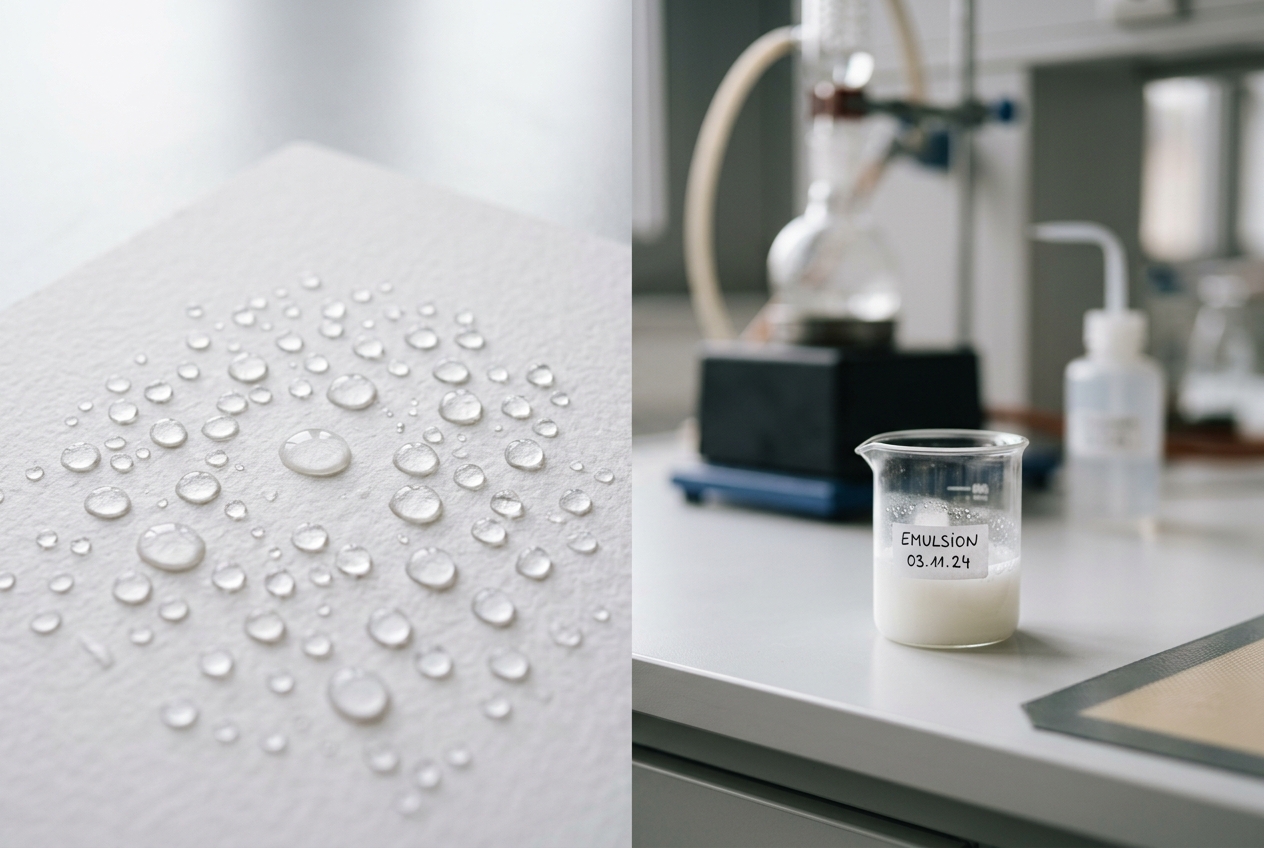
AKD is a wax emulsion. To size the sheet it must:
- Be retained on the fibre (it has no natural affinity of its own),
- Survive the wet end without hydrolysing,
- Spread and react with cellulose in the dryer section.
Anything that interrupts one of these three steps means AKD leaves with the backwater or sits unreacted in the sheet. You pay for it either way.
Six levers that actually reduce dosage
1. Fix retention first
Check first-pass retention of AKD (a simple Cobb on the wire-side vs headbox consistency test works). A well-tuned retention & drainage aid program often improves AKD retention by 15-25%, which is the single biggest saving available.
2. Use an AKD booster
A cationic AKD booster / promoter anchors the emulsion particle to the fibre and accelerates curing. Typical result: same Cobb at 20-30% lower AKD dosage, plus faster size development off the machine.
3. Control anionic trash
Dissolved and colloidal substances from recycled fibre consume cationic charge and "blind" AKD particles. Measure cationic demand and neutralise it with a coagulant upstream of the AKD addition point.
4. Get the addition point right
Add AKD after the pressure screen but with enough mixing time before the headbox. Adding too early exposes it to hydrolysis; too late and it never contacts the fibre.
5. Watch pH, alkalinity and temperature
Keep headbox pH 7.5-8.5 and avoid high alkalinity (> 300 ppm as CaCO₃). Stock above 50°C dramatically speeds AKD hydrolysis.
6. Reduce sizing demand from fillers
High filler (especially high PCC) surface area soaks up size. Improving ash retention and using a filler pre-treatment lets you hold Cobb with less AKD.
What "good" looks like
A typical 100 TPD writing/printing mill that tunes retention, adds a booster and neutralises trash usually sees:
- AKD dosage reduced from ~1.2% to 0.8-0.9% on fibre
- Faster size development (Cobb stable at the reel, not after 24 hours)
- Cleaner backwater and fewer size-related deposits
Start with a survey
Before changing dosage, run a wet-end survey: charge demand, conductivity, pH, first-pass retention and Cobb at the reel and after 24 hours. That data tells you which lever to pull first.
VB Global supplies eco-friendly AKD, AKD Booster, cationised starch, retention aids and coagulants, and our technical team can support the survey and mill trial.