Anionic Trash Control (ATC): The Fix for a Dirty Wet End
Recycled fibre brings a flood of dissolved and colloidal anionic material into the wet end that quietly eats your starch, AKD, dyes and retention aid. Anionic Trash Control with VB Global's AS ATC 1300 neutralises it at source – here is how it works, how to dose it and what it saves.
If your mill runs on OCC, mixed waste or any recycled furnish, you already know the symptoms: cationic demand that keeps creeping up, starch and AKD that no longer give the result they used to, dyes bleeding into the backwater, sticky deposits on felts and wires, and a retention aid dosage that keeps climbing. All of these have one common root – anionic trash – and one common cure – Anionic Trash Control (ATC). VB Global's AS ATC 1300 is formulated precisely to resolve this issue.
What is anionic trash?
"Anionic trash" is the papermaker's name for dissolved and colloidal substances (DCS) that carry a negative charge: hemicelluloses, lignin fragments, fatty and resin acids, pectins, residual coating binders, adhesives, de-inking surfactants and dispersed stickies. Recycled fibre is loaded with them, and closed water circuits concentrate them further with every pass.
Because almost every functional wet-end additive – cationic starch, AKD emulsion, dry strength resin, dyes, OBA carriers, retention polymers – is cationic, the anionic trash reacts with them first. The additive is consumed before it ever reaches the fibre, and the complex either leaves with the backwater or forms deposits.
How to recognise the problem
| Symptom on the machine | What it really means |
|---|---|
| Rising cationic demand (> 150–200 µeq/l) | Trash load is building up in the circuit |
| Starch or AKD dosage rising for the same result | Additives are being "blinded" by trash |
| High backwater turbidity / COD | Fines, colloids and unretained additives washing out |
| Sticky deposits, holes, breaks | Dispersed stickies destabilised by shear and pH swings |
| Retention aid efficiency dropping | Polymer consumed by colloids instead of bridging fibre |
| Shade drift, dye in backwater | Anionic dyes competing with trash for fixing sites |
What ATC does – and how AS ATC 1300 resolves it
An Anionic Trash Control agent is a low-molecular-weight, very high charge-density cationic polymer (typically polyDADMAC, polyamine or specialised blends). AS ATC 1300 is VB Global's ATC product for recycled-fibre machines. Dosed into the thick stock, it:
- Neutralises the anionic charge of dissolved and colloidal substances, bringing cationic demand down to a controlled window.
- Fixes colloids and micro-stickies onto fibre in a finely dispersed, harmless form, so they leave with the sheet instead of agglomerating into deposits.
- Protects the functional additives – starch, AKD, DSR, dyes and OBA now reach the fibre and do their job at the designed dosage.
- Lets the retention aid work – the high-molecular-weight flocculant is no longer wasted on colloids and can bridge fines and filler.
Think of AS ATC 1300 as the primer coat: without it, every chemical applied afterwards performs below its potential.
Results mills typically see with AS ATC 1300
- Cationic demand stabilised in the target range and far less variable shift-to-shift
- 10–25% lower starch and AKD dosage for the same strength and Cobb
- Clearer backwater, lower COD/BOD load to the effluent plant
- Fewer stickies-related breaks and longer felt and wire life
- Better retention aid efficiency and more uniform formation
- Steadier shade and better dye yield on coloured grades
Dosing guidelines for AS ATC 1300
- Addition point: thick stock – pulper discharge, blend chest or machine chest. AS ATC 1300 needs residence time and good mixing before the other cationic additives are added.
- Sequence: AS ATC 1300 first → cationic starch / AKD / DSR → retention aid last (after the pressure screen).
- Dosage: typically 0.5–2.0 kg/tonne of paper for recycled furnish, set by cationic demand measurement, not by a fixed number – aim to reduce demand, never to over-cationise the system.
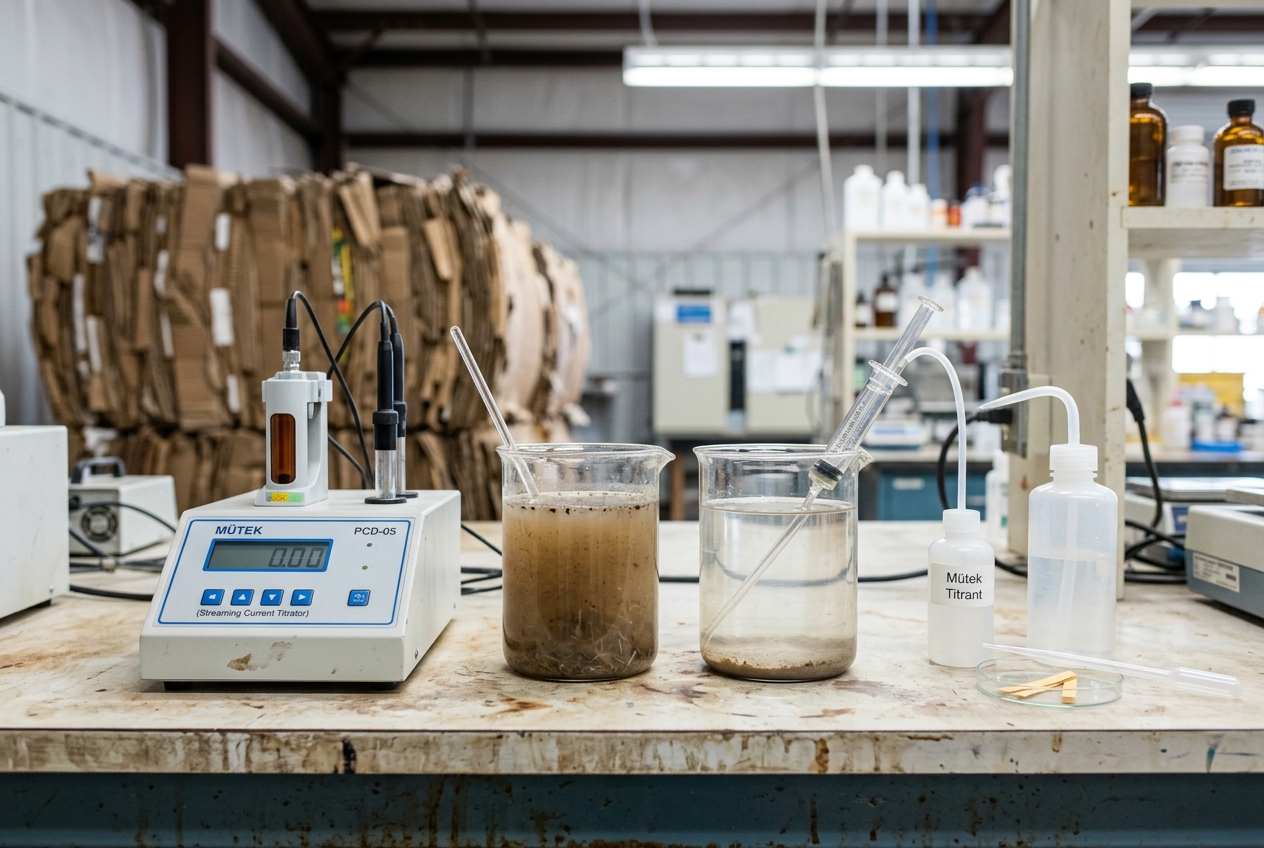
- Control: measure cationic demand (streaming current / particle charge detector) at the headbox at least once per shift; adjust the AS ATC 1300 pump to hold the target window.
- Avoid: dosing AS ATC 1300 together with anionic additives at the same point, and over-dosing – an over-cationic system reverses the problem and hurts retention.
A simple AS ATC 1300 trial plan
- Baseline 3–5 days: cationic demand, conductivity, starch/AKD kg/t, first-pass retention, backwater turbidity, deposit inspection.
- Start AS ATC 1300 at 1.0 kg/t in the thick stock; track cationic demand every two hours.
- Once demand is stable, step starch and AKD down 10% at a time while holding strength and Cobb targets.
- Record savings, deposit reduction and break frequency over the following two weeks; lock in the dosage and add it to the shift log.
Summary
Anionic trash is the hidden tax on every recycled-fibre machine. Anionic Trash Control removes that tax at source – stabilising cationic demand, protecting your starch, AKD, dyes and retention aid, and keeping the machine clean. For most recycled-fibre mills it is the single highest-return wet-end chemical, and AS ATC 1300 will resolve the issue.
VB Global supplies AS ATC 1300 for your machine.