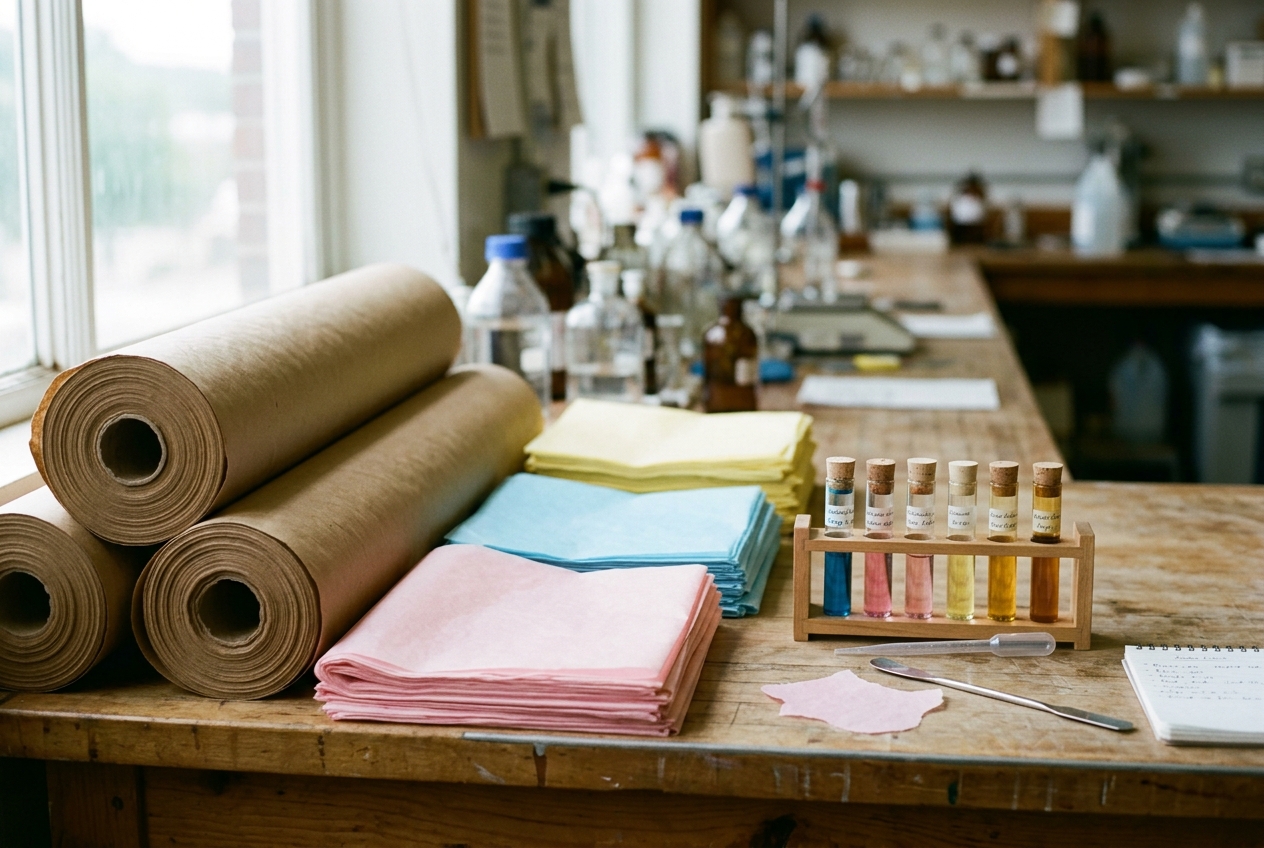
How OBA (Optical Brightening Agents) Boost Paper Whiteness
Brightness and whiteness are not the same thing, and bleaching alone cannot reach the whiteness buyers expect. Learn how di-, tetra- and hexa-sulphonated OBAs work and where to add them.
Ask a buyer what they want from copier or printing paper and the answer is almost always "whiter". Yet pushing bleaching further is expensive, damages fibre and hurts yield. This is where Optical Brightening Agents (OBA), also called Fluorescent Whitening Agents (FWA), do their work.
Brightness vs whiteness
- ISO Brightness measures reflectance at 457 nm (blue light). It tells you how well the pulp was bleached.
- CIE Whiteness describes how white the sheet looks to a human eye under daylight, including its blue-yellow tint.
Bleaching raises brightness. OBA raises whiteness, and can lift CIE whiteness by 20-40 points on top of what bleaching alone achieves.
How OBA works
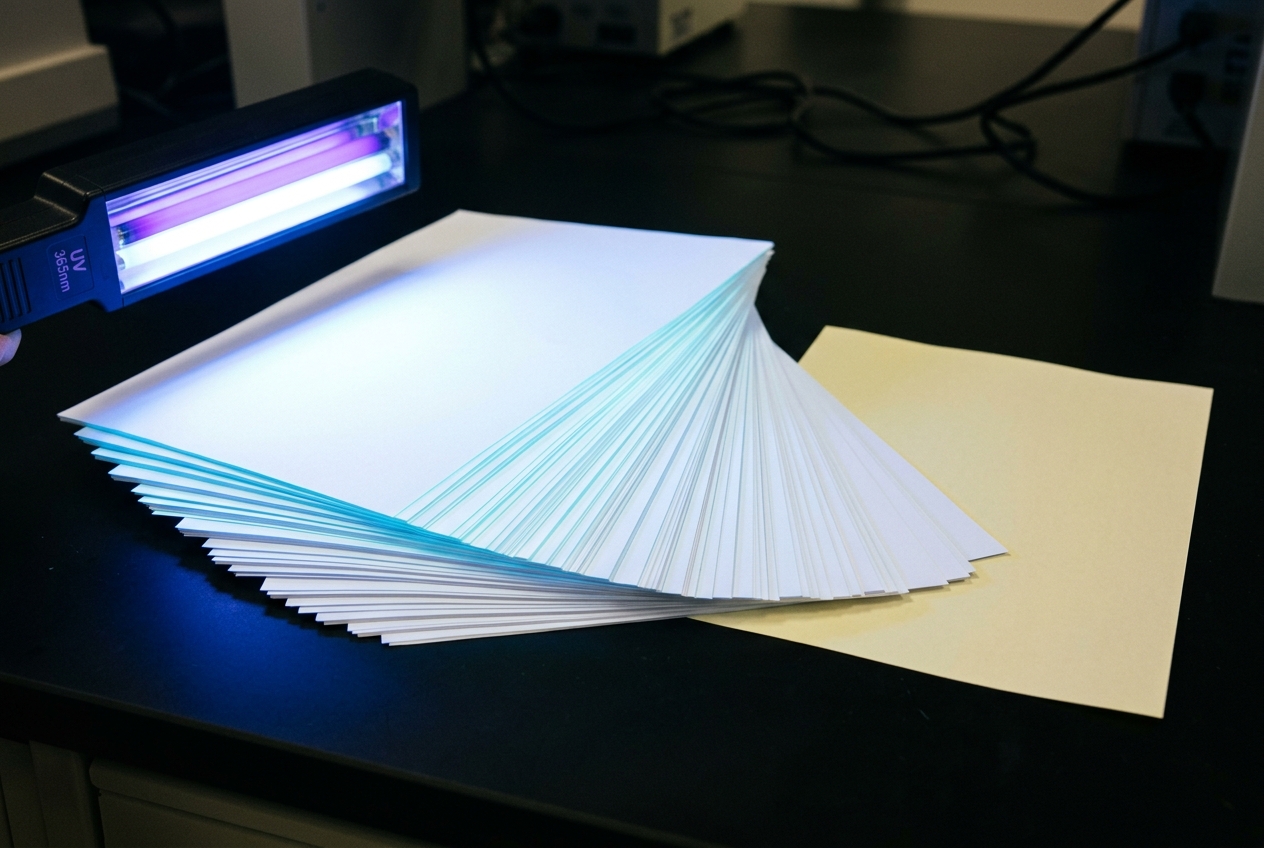
OBAs are stilbene-based molecules that absorb invisible UV light (340-370 nm) and re-emit it as visible blue light (420-470 nm). The added blue cancels the natural yellow cast of cellulose and lignin, so the sheet appears brilliantly white. Because they add light rather than remove colour, OBAs are the only way to exceed 100 whiteness.
Di, Tetra and Hexa – which grade?
| Grade | Where it works best | Notes |
|---|---|---|
| Di-sulphonated | Wet end | Highest fibre affinity, most economical, lower solubility – ideal for bulk whiteness |
| Tetra-sulphonated | Wet end & size press | All-rounder, good solubility and good affinity |
| Hexa-sulphonated | Size press & coating | Highest solubility, works in high-solids starch and coating colour, best for top whiteness |
Most mills run a di- or tetra-sulphonated OBA at the wet end for base whiteness and a hexa-sulphonated OBA at the size press or coater for the final boost.
Getting the most from every kilo
- Use a carrier: OBA needs a carrier such as starch, PVOH or CMC to hold it in a planar orientation. Without a carrier, especially in coating, it "greens" and stops brightening.
- Mind the quenchers: Cationic retention aids, PAC/alum and cationic dye fixatives can quench OBA fluorescence. Dose OBA after strong cationics or use OBA-friendly grades.
- Avoid over-dosing: Beyond the saturation point extra OBA gives a greenish tint and lower whiteness. Run a dose-response curve; the knee is usually 0.3-0.8% at wet end.
- Keep pH neutral to mildly alkaline – acidic conditions reduce OBA efficiency.
- Check shade: OBA shifts the sheet blue. Pair it with a touch of violet or blue direct dye to hit the target shade (b* value) without wasting OBA.
Where OBA pays back fastest
- Copier and writing/printing grades chasing ≥ 150 CIE whiteness
- Recycled-fibre grades where bleaching cannot economically reach target brightness
- Tissue and board where a brighter appearance commands a premium
Summary
OBA is not a substitute for bleaching – it is the multiplier that turns bleached brightness into the visual whiteness customers actually buy, typically at a fraction of the cost of extra bleaching stages.
VB Global supplies di-, tetra- and hexa-sulphonated OBAs suitable for wet-end, size-press and coating applications. Talk to our team for a whiteness optimisation trial.