Choosing the Right Dye for Kraft vs Tissue Paper
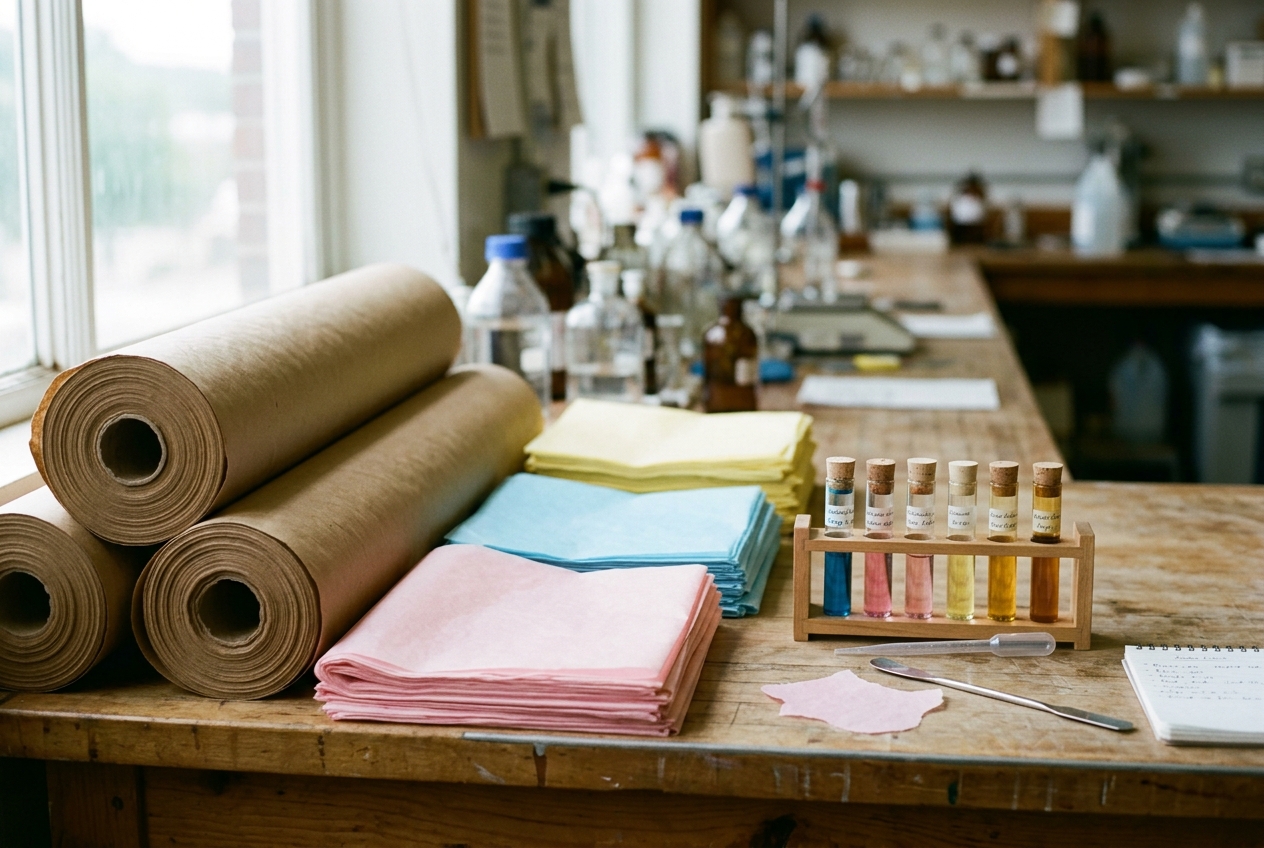
Kraft and tissue behave very differently at the wet end. Here is a practical guide to picking between direct, basic and acid dyes so you get the shade you want at the lowest cost.
Coloring paper sounds simple until the shade drifts from reel to reel, the backwater turns colored, or the dye simply refuses to stay on the fibre. The root cause is almost always the same: the dye chemistry does not match the furnish. Kraft and tissue are the two most common cases where mills get this wrong.
Understand your fibre first
Kraft and recycled board are rich in lignin and fines. The fibre surface is strongly anionic (negatively charged) and the stock is usually unbleached or semi-bleached. High ash and high conductivity are common.
Tissue and specialty grades use bleached, clean fibre with very low lignin. The sheet is light (13-25 gsm), formed fast and often demands bright, level pastel shades.
Which dye class fits where
Direct dyes
Direct dyes are anionic and have a natural affinity for cellulose through hydrogen bonding. They work best on bleached and semi-bleached furnish and give good light fastness. On kraft they are acceptable for economical brown, orange and yellow shading, but they struggle to give deep shades without a cationic fixing aid.
Basic (cationic) dyes
Basic dyes carry a positive charge and are strongly attracted to lignin-rich, anionic fibre. That makes them the first choice for unbleached kraft, recycled board and coloured tissue where brilliance matters. They have very high tinctorial strength, so dosage is low and cost per tonne is attractive. Their weakness is light fastness, so avoid them for archival or long-exposure grades.
Acid dyes
Acid dyes are anionic with low natural affinity for fibre; they need a cationic fixing agent to retain. In return they give extremely bright, level shades and excellent solubility. They are ideal for tissue, napkins and decorative papers where levelness and brilliance are more important than fastness.
Quick selection table
| Requirement | Kraft / Recycled | Tissue / Bleached |
|---|---|---|
| Economical shading | Direct + fixative | Direct |
| Brilliant deep shade | Basic | Acid + fixative |
| Best levelness | Basic | Acid |
| Light fastness | Direct | Direct |
Practical dosing tips
- Add dye where mixing is good – thick stock or mixing chest, never straight into the headbox.
- Watch conductivity: above 2000 µS/cm most anionic dyes lose retention. Add a low-molecular-weight cationic fixative before the dye.
- Keep pH between 6 and 8 for direct and basic dyes; acid dyes tolerate a slightly lower pH.
- Do not overdose OBA on coloured grades – it shifts the shade towards blue and wastes chemical.
- Trial in the lab first with a handsheet at mill water conductivity, not with distilled water.
The bottom line
Match charge to charge: cationic basic dyes for anionic, lignin-rich kraft; anionic direct or acid dyes (with fixative) for clean, bleached tissue. Get that right and shade consistency, backwater clarity and dye cost all improve together.
Need help matching a shade card? VB Global supplies Direct, Basic and Acid dyes along with OBA and cationic fixatives, and our team can run the lab trials with your own furnish.