
Paper Machine Shower Maintenance: A Practical Checklist
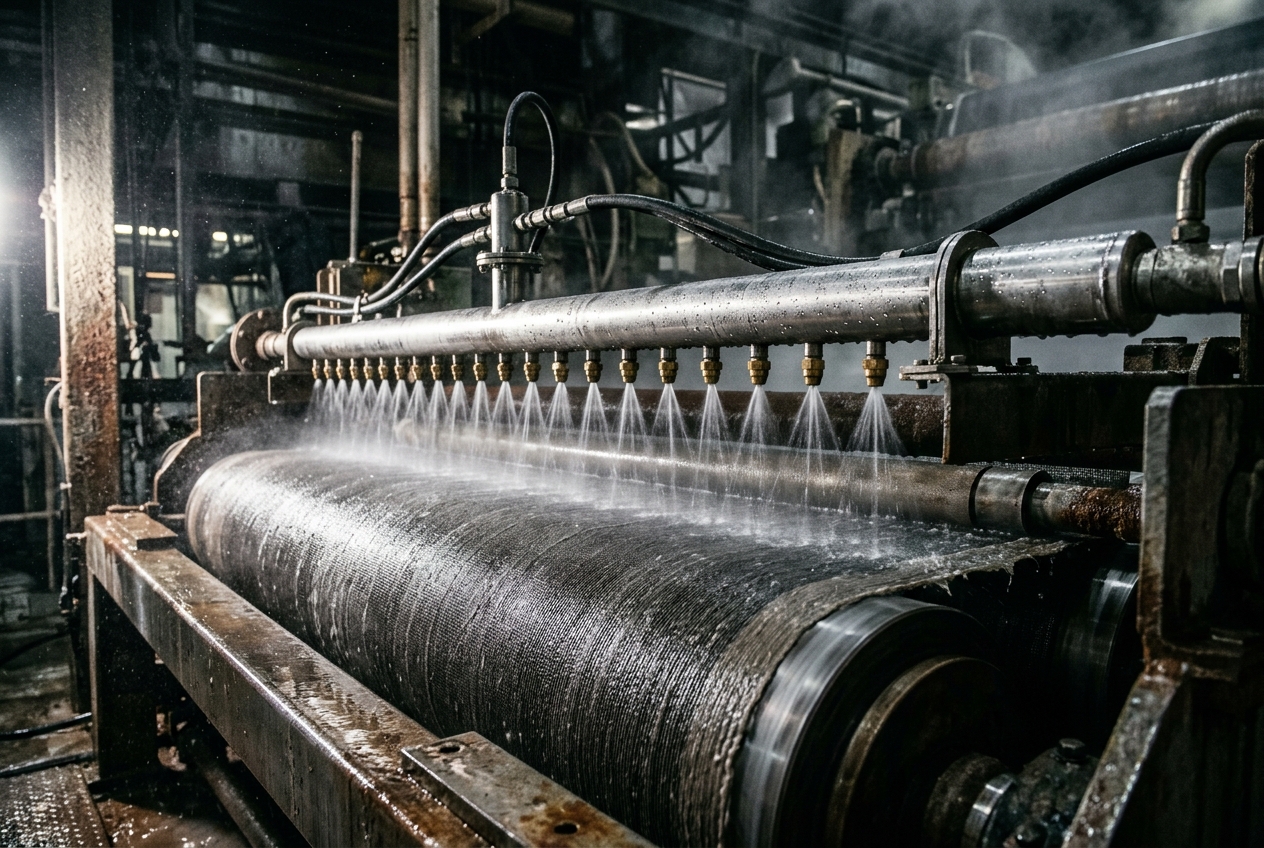
Dirty fabrics, streaks, holes and short felt life usually trace back to neglected showers. Use this daily, weekly and shutdown checklist to keep high-pressure and oscillating showers performing.
Showers are small, cheap components that decide the life of very expensive fabrics and the cleanliness of the whole machine. A single blocked needle-jet nozzle on an oscillating shower can leave a permanent dirty streak on a forming fabric, cause sheet holes and force an early fabric change worth lakhs of rupees. Yet showers are often the least inspected item on the machine.
Why showers fail
- Blocked nozzles from fibre, scale, fines or rust particles in shower water
- Worn orifices – a 0.8 mm nozzle worn to 1.0 mm passes 55% more water at a lower pressure and loses its cutting action
- Oscillation failure – a stalled oscillator cleans one narrow band and streaks the fabric
- Misalignment – jets hitting rolls, edges or each other
- Pressure drop from a dirty strainer or partially closed valve
Daily checks (operators)
- Walk every shower and confirm a uniform spray pattern – no missing, weak or fanned jets.
- Check shower pressure against the set point on each gauge (typically 20-40 bar for high-pressure needle showers, 2-5 bar for lubrication/low-pressure showers).
- Confirm each oscillator is moving across its full stroke and reversing smoothly.
- Look for fabric streaks, wet lines or dirt bands – they point straight to the failing nozzle.
- Check the duplex filter differential pressure and switch baskets if needed.
Weekly checks (maintenance)
- Purge or brush-clean high-pressure shower pipes; open end caps and flush.
- Clean duplex filter baskets and inspect for damage.
- Inspect nozzle wear with a go/no-go gauge; replace nozzles > 10% oversize.
- Verify shower angle and distance to fabric (usually 15-30° against fabric travel, 100-150 mm distance for needle jets).
- Grease oscillator drives and check stroke length equals nozzle spacing.
Every shutdown
- Remove and descale shower pipes (citric or dilute acid soak) where hard water is used.
- Replace worn nozzles across the full shower rather than one-offs so the pattern stays uniform.
- Check brush showers: bristle wear, brush rotation, and that brush pressure on the fabric is even.
- Inspect tube-in-tube showers for internal tube alignment and cleanliness.
- Confirm edge-cutting / trim squirt nozzles give a sharp, stable cut with no fibre build-up.
Water quality matters
Most nozzle blockages come from the water, not the fabric. Use filtered clarified water (≤ 50 µm, ideally 25 µm for needle jets) and install duplex filters so cleaning can happen without stopping the shower. Using clean fresh water on only the final high-pressure shower and clarified water elsewhere balances cost and reliability.
Upgrade options that pay back
- Electromechanical variable-speed oscillators that match speed to machine speed for full coverage
- Stainless steel needle-jet nozzles with ruby/sapphire inserts for 5-10× longer life
- Tube-in-tube showers that let you clean the pipe without losing production
Summary
Ten minutes of shower inspection per shift protects fabrics worth crores per year. Put the checklist on the machine floor and make shower pressure and pattern part of the shift log.
VB Global supplies stationary, oscillating, brush and tube-in-tube showers, high- and low-pressure nozzles, trim squirts and duplex filters, and can audit your existing shower system.